Friday, 10 April 2009

Delhi

Since I only had one day in Delhi, I went into full-on hectic tourist sightseeing mode. Normally, when I visit a city, I'll have picked out in advance a few places and museums that I want to see and then spend the rest of the time exploring various neighbourhoods. It seemed clear to me that that approach would not work here, especially in so short a time frame. I had done almost no research on the city and was somewhat daunted by it. So I put myself in the hands of Delhi Tourism's full day sightseeing tour - 6 monuments in 9 hours, making our way between them by coach.

In many ways it was awful. I got no sense of the city. The guide was terrible and I know almost no more now about Delhi and its monuments than when the tour started. Being propelled from place to place is exhausting and we only had about 45 minutes in each place, which was not really enough time to appreciate much of anything properly. We saw far more than one can reasonably take in in a day. When I looked over my photos a couple of days later, I came across images of places I absolutely do not remember seeing! Keeping up with a large group is troublesome and at one point, in the busiest place, I got separated from them just as we were due back on the bus and was terrified that I would be left behind.

OK. That's the negative side out the way. There was plenty about the trip that made it worth doing. Although having to keep up with the group was a drag, I did meet one charming and bright guy, Nimish, with whom I chatted most of the day and, on account of him, had a much better time then I would have otherwise.

And then, of course, were the monuments themselves. That we saw so much can also be appreciated in a glass-half-full way. The first place we visited, the fairly modern (1939) Lakshmi Narayan Temple left me completely cold. Next up was the Lotus Temple, which is a Bahai House of Worship. That was splendid. To get to the temple itself you have to walk through the gardens which, though not nearly as impressive as the Bahai Gardens in Haifa, were lovely nonetheless with the neat, manicured and green lawns and trees in stark contrast with anything I'd seen in Kathmandu in the previous two months. The temple itself reminded me more of a space ship than a lotus flower though:

I can appreciate that the inside of the Temple would be a lovely place to worship (except for the constant stream of tourists). Although extremely plain, the cavernous space reminded me of a cathedral and filled me with a similar sense of contemplative awe.

Next up was the Qutub Minar, a 72.5m high victory tower in the Afghani style that was begun in the twelfth century. It's an imposing monument, set among the ruins of buildings that were evidently once equally impressive but about which I can tell you nothing. Although I have photos of the whole Minar, I've chosen instead to show you a picture of the detail of some of the carving around the pillar:

After a much needed lunch break, the tour continued to the Red Fort. It's a vast place, with several beautiful and imposing buildings, built by Shahjahan, who also commissioned the Taj Mahal. Unfortunately the crowds, heat and frustrations of the tour as described above, plus the sightseeing-fatigue that was beginning to kick in, all got the better of me and I really didn't enjoy my time there nor appreciate what is supposedly the most impressive place in Delhi.

Moving on the Rajghat, a monument that marks the site where Gandhi was cremated. It was a calm and peaceful place, much appreciated after the Red Fort. I enjoyed myself there more than I had expected and it went some way to restoring my spirits.

The last stop was Humayun's Tomb and by that time I was so exhausted that I almost didn't even get off the bus. But knowing that the end was in sight, as well as my deep-rooted fear of missing out on something worthwhile, gave me a final boost of energy. And thank goodness for that, because Humayun's Tomb is absolutely wonderful, by far the best place we saw all day. Built in the 16th century by the widow of the third Mughal king for her husband, it is supposedly a prototype of the Taj Mahal. Set in beautiful and peaceful gardens, the Tomb as a whole is simply magnificent:


The detail close up is just a inspiring, especially for someone with such a fondness for Islamic geometric designs:


Exhausted, I collapsed back at the hotel in the early evening and remained there the rest of the night. As busy as my Delhi excursion had been, I had an even more intense sightseeing experience lined up in Agra for the next day. That was so excellent that it'll take me four posts to cover it all, but for those you'll have to wait.

Mussoorie

After a whirlwind week in India, I'm now back in Kathmandu, with plenty to tell about the trip, which I will be doing in six separate posts.

First up, Mussoorie.  After flying into Delhi and spending the night there, we (Sapna, Sandhya, Supreet, Sangita and myself) left very early in the morning for New Delhi train station.  Six hours on the train and an hour in a taxi later, we were in the 'Queen of the hill stations'.  I'm not quite sure how I got it into my head that Mussoorie is off the beaten tourist track, because I couldn't have been more wrong about that.  It's been a popular retreat ever since the British colonialists designated it as a cool (literally) place to hang out in the summer.  Now it receives throngs of tourists, mainly Indians from Delhi, who are likewise keen to escape the heat.  The town itself, centred along an approximately 2km strip called The Mall, is tacky and charmless and our hotel an unfortunate combination of drab and expensive.  The thought of spending three days there made my heart sink.

My low first impressions meant that things could only get better, and thankfully they did.  The evening of our arrival we went to pick up Uzir (Sapna and Rabi's son) at his school, a little further up in the hills from The Mall, from which there were lovely views over the town and valley.  I was delighted to meet Uzir after hearing so much about him.  He's a lovely guy.

The next day Sapna and the rest of the gang had to visit family in Dehra Dun, about an hour down the hill from Mussoorie, where they were to spend the day.  I opted to stay in Mussoorie, went to the tourist office and the rest of the day followed the itinerary that the official there set for me.

That started by taking a cycle rickshaw a short ride away from The Mall to the rather charmingly named 'Happy Valley'.  The main attraction there is the Buddha temple.  The temple itself is nothing special but the location is marvelous, a half hour climb from where the rickshaw dropped me off, with really spectacular views over fir tree covered hills and, beyond that, the Himalayas.  Then it was back to the rickshaw and on to the Municipal Gardens, which, my tourist brochure informed me, used to be a botanical garden.  Before deciding to go there, I should have paid more attention to the words 'used to be' and thought to inquire what it is now.  It's now an extraordinarily tacky amusement park, full of photo touts, the most dismal looking fairground rides I've ever seen and tinned music piping that ruined any chance of at least quietly contemplating the view.  I left promptly.

The rickshaw dropped me back into town from where I caught a tourist bus to Kempty Falls, an apparently lovely and popular waterfall 13km from Mussoorie.  At first sight it turned out to be both far less lovely and far more popular than I would have hoped.  Once again, my heart sunk as the bus pulled up along dozens of other tourist buses and heaving crowds made their way down a road lined with any kind of store you can imagine that has been designed with the sole purpose of parting tourists from their money.  To make matters worse, I couldn't even find the falls or the cable bar that ran to the bottom of them, though the view of them from the bus suggested that it wouldn't even be worth it.  And I still had almost two hours until the bus back.

Eventually I found a stair way that lead up the falls and found there a number of pools in which one could swim.  Hundreds of other people had found them too and were happily splashing away.  So I climbed higher, finding more pools and fewer people.  Though I never found the total solitude that the crowds at the bottom had left me craving, I did eventually come to a lovely, relatively quiet spot, away from all the vendors, with a good view of the falls coming down over the rocks, between the trees.  There was also a very tempting little pool.  I settled down on a rock, cursing the fact that I didn't have my swimsuit whilst coming to the conclusion that the only way that I wouldn't think the trip I was a total waste of time was if I got into the water.  Paddling only got me so far.  I NEEDED to swim.  Remembering that I had a spare T-shirt in my bag, I finally worked up the courage to throw caution to the wind, stripped down to my pants and T-shirt and took the plunge.  It was refreshing, invigorating and totally worth having to go without underwear for the rest of the day.  Finally glad that I had come, I happily made my way back to the bus and into town.  And then I walked.  And walked and walked.  From the bus stop, I took Camel Back Road to the other end of town, the only alternative to walking down the Mall again.  A stroll down the Mall gives some lovely views over the vast Dehra Dun valley, whilst the road I now took is a designated scenic route with views across the mountains.  You can see the the Himalayas on a clear day.  From there I went up into the suburb of Landour.  Although only 300m from the Mall, it feels like a totally different place, having an actual bazaar of shops for local people.  Then past the bazaar and up further into the hills which, needless to say, offered more fine views.  This is a photo of Woodstock School, which Uzir attends.  As you can see, the buildings are rather spread out but it's undoubtedly a lovely setting:


And here's a view back down over Mussoorie:


The next day, the family wanted to shop and relax in the hotel, which was pretty much the complete opposite of what I wanted to do.  I wanted to walk more and that's exactly what I did.  I walked almost solidly for six and a half hours, probably covering somewhere between 20 and 25 km, taking largely the same route as the day before, first to the lookout from Gun Hill, then back to the Buddha Temple (all the time I was in the cycle rickshaw I thought about how lovely the route would have been to walk), then around the town on Camel Back Road and up through Landour into the hills, going higher this time.  Mussoorie itself is just over 2000m above sea level and I reckon I climbed another 500 or so above that.  I couldn't have enjoyed the day more.  I was glad for the exercise, appreciative of the scenery and overjoyed by the deliciously fresh, crisp and cool air.  It all bodes very well for trekking.

During the walk I had met a retired British couple and they invited me to go with them the next day to a place called Sister's Bazaar.  I had no other plans so accepted, despite not knowing what Sister's Bazaar was.  We took a taxi which climbed even higher into the hills than I had walked the day before and arrived at the place.  It was essentially a convenience store, in many ways not dissimilar to any corner store you'd find in England, with shelves stocked with Walkers biscuits and Marmite, and a proprietor who made his own cheddar cheese.  Yet there was something infinitely charming about finding such a place in the unlikeliest of locations.

And so it was that by the time we left Mussoorie later that afternoon, I had developed a much more favourable attitude towards the place and overall will have fond memories of my time there.  We made our way back to Delhi, about which I shall have plenty to say in my next post.

Thursday, 2 April 2009

The original plan

My last post has, unsurprisingly, given rise to lots of e-mails, particularly from my family who, once they got over the shock, were really excited and delighted for me. They are glad that I'm so happy here and open to new opportunities. Mum was almost immediately making travel plans to come and visit me in November.

It is therefore with some regret that I drew their attention, as I now draw yours, to the date of that post, April 1st. Happy April Fools!

I think the reason that it was so convincing is because it is almost entirely true, expect of course the crucial part about being offered a job and deciding to accept. I am really having a wonderful time here and am very happy. I am sure that I will maintain close ties with Nepal, especially because of Nishant. Mum is also going to sponsor a little girl, Jenisha, so hopefully we'll come and visit together in the next two or three years. Moreover, I have a number of friends here now. But I could never actually live here and am still very excited about the PGCE, not to mention the rest of my travels. It's been an amazing few months but I'll be ready to leave when my previously designated time is up.

Tuesday, 31 March 2009

MotherCare

I've been promising to write about MotherCare for ages and, just as my time there is nearly up (tomorrow will be my last day), I'm finally getting around to it. I'm pretty sure I've already written some of this is earlier posts, but I can't remember what and I don't want to waste precious electricity time rereading my blog, so my apologies if some of this is repetitive.

MotherCare is run by Sapna, who is an extremely commited educator. It's a pre-school, taking kids up to six years old. It's based on Montessorie principles, although I don't know enough about that to tell how well they're upheld. All the teachers are well trained and committed and the school is well staffed; each classroom has a main teacher, at least one assistant and a didi (a woman responsible for cleaning up, serving lunch etc).

The kids are from a very comfortably off section of Nepali society, with many parents being prominent business people, doctors, etc. There's also a sizable, though not overwhelming number, of foreign kids.

The school is has a large, shady playground, full of climbing frames, swings, a sandbox and even a small pool. Here's a section of it:


The classrooms are huge. Each year group actually has a suite; a main classroom, a carpeted area for indoor play and reading and a changing/bag storage area. The rooms are immaculately clean and tidy, light and well-resourced, with colourful poster-boards and displays, alphabets and number charts adorning all the walls:

The photo above is of Jupiter class, in which the pupils are aged 5-6. This is the class in which I've spent my time. Sapna is the main teacher although she's frequently occupied in the school office. That leaves Sveta is charge, with me and another assistant, Sharmila, helping out however we can.

The school year runs from May-April, so it was already nearly over when I arrived (graduation is tomorrow). From the maths point of view, the curriculum had already been covered, so there was no actual teaching to do. I was, however, put in charge of the maths lessons, which happen twice a week. It was all revision, mostly of addition and subtraction. The challenge for me was to think of ways to make it fun, fresh and interesting. I got off to some false starts, particularly when trying to explain things in a way that was familiar to me from teaching in England and Canada but went down like a lead balloon over here (the concept of the number-line, for instance). I also had a tough time keeping the class under control and getting them to listen to me. But eventually I broke through and by the end had devised a few good games which the kids enjoyed, whilst simultaneously practicing their number skills.

Other than maths, the kids also learn Nepali, practice their English reading and handwriting, do lots of drawing and painting, learn special topics (in the time I've been there they've covered the continents, land and water forms and food and nutrition), and have weekly music and occasional dance lessons. They also have plenty of time for play, both inside and outdoors. It's a small class but they're a mixed bag, from the quiet and studious ones to the real troublemakers, but I guess that's what you'd expect from a bunch of kids anywhere in the world.

There's one small annoyance. Because of Nepal's electricity problems, it's troublesome to get stuff photocopied. That means that every time I've wanted to create a worksheet, I've had to write the entire thing by hand 18 times! It's not that bad though. There's always plenty of time.

As you can probably tell from what I've written and the photos, MotherCare is completely the other end of the spectrum from OGN. The kids are all clean, well-fed and healthy. The school itself wouldn't be out of place in England or Canada. I feel very lucky to have had the opportunity to experience both. I've learnt a great deal from each.

Monday, 30 March 2009

Double meanings

One thing I still find disconcerting about being in Kathmandu is the abundance of the following two symbols (here seen together on a balcony):

As a Jew, these of course conjure up certain images and emotions. The swastika is particularly hard to take. Yet here the swastika is a sanskrit symbol for good luck and what I call the Magen David (Star of David) is a sanskrit symbol for wisdom.

Some more OGN snaps

There seems to be a general consensus that the OGN kids are adorable, so who am I to hold back on such cute photos as I took today?

Playing up before nap time:


Susmita, after a breakthrough. Last time I mentioned her, she wasn't talking or moving. Today, suddenly, she did both. She just got up and started walking around. And once she started she barely stopped, whilst all the volunteers looked on in amazement. But it got better. When she was put down to her nap, Jenny, another of the volunteers, was playing peek-a-boo with her. Susmita started to gurgle happily, the first noise (other than crying for her first few days) that we'd heard her make. A few moments later and she was stringing together syllables (nonsensical, of course, but that's all you'd expect at a year old). The volunteers were entranced. She's like a whole new child from the miserable lump of skin and bones that was first brought in about a month ago. Here she is today:

Gore (pronounced as two syllables, Go-re), is regarded by all the volunteers to be without question the cutest kid at OGN (and, as you've seen, there's some serious competition for that distinction). Here he is, with Maria, having just made a huge mess of himself consuming some snack-time nutrient-rich powder:

In addition to all the cuteness on display here, there was also the enchanting sight of the kids running around in an amazed mass after the bubbles which one of Jenny's friends had brought from America. I don't think they'd ever seen bubbles brought before and they probably wouldn't have been more in awe if the Messiah appeared in front of them.

Also, I had the delightful task of telling Bina that my Mum has agreed to become an education supporter for a little girl there called Jenisha, a most needy and worthy child for such support. It is her house and family situation that is described and shown in the 'Poverty and OGN' post. Bina was over the moon and, as much as Jenisha really understood what was going on, she seemed pretty pleased as well.

It was a very happy day.

The next few weeks

Having settled well into the pace of Kathmandu, MotherCare and OGN, the next few weeks will bring a complete shake up. I can't believe how much cool stuff I'm going to be doing in the next short while. My itinerary is as follows:

On April 2nd I'm heading to India for a week. I'm going with Sapna and Sandhya (Rabi's sister) and we'll be joining with Supreet and Sangita, who now live in Delhi. The main purpose of the trip is to visit Uzir (Sapna and Rabi's 15 year old son) who is at boarding school in Moussourie, a north Indian hill station, a six hour train ride plus an hour and a half drive from Delhi, way off the beaten track. Apparently it's beautiful there, with lots of good hiking. Everyone in the party except Sapna is keen on walking, so I imagine we'll do a fair bit. We'll also have a couple of days in Delhi and I plan to use one of them for a day trip to visit Agra and see the Taj Mahal (rather more on the beaten track).

I then have a couple of days back in Kathmandu before heading on another Sacred Summits motorbiking weekend. This time the destination is The Last Resort, right on the border between Nepal and Tibet. At The Last Resort we'll have a chance to experience one or two of the adrenalin pumping activities on offer; bungee jumping, canyoning swinging, mountain biking, white water rafting. Needless to say I'm pretty psyched.

And as if that wasn't enough, the day after we get ack I'm heading off on a 16 (or so) day trek around the Annapurna circuit, supposedly the best trek in Nepal. The reason it's considered as such is because it offers the greatest variety of scenery, villages and peoples. The highest point is over 5400m, about as high as you can get without climbing a mountain (it's about 600m higher than Mont Blanc). I anticipate the trek to be one of the highlights of my entire gap year. Vivek will be the guide. I've also found a couple of other people to go with; Maria, one of the other OGN volunteers, and a guy called Henry who's doing a photojournalism internship in Kathmandu and living in the same place as Maria. I think we'll all get on pretty well. It should be more fun with a couple of other people, plus it splits the cost.

It gets even better. On the way back from the trek, I'm going via Chitwan National Park for a couple of days in the jungle; elephant safari, jungle walks and canoe rides await.

Seriously, how did I get to be so lucky? Only downside, I probably won't be blogging much (certainly not whilst I'm trekking), but I'm hoping (electricity permitting) to put up a couple more posts before I go. I took some photos at OGN today that are so adorable that they need to be seen to be believed. So you have that to look forward to.

Thursday, 26 March 2009

Nishant (and Kathmandu schools)

As you may have gathered from my previous posts about OGN, I have become rather attached to the place and the children there and want to help them as much as I can. As I have mentioned before, one of Bina's main concerns is that the kids receive a decent education once they leave OGN. As far as she's concerned, this involves sending them to a private school. Government schools in Nepal are dire, especially in Kathmandu. At private schools, unlike government schools, most of the teaching is done in English, a distinct advantage when it come to securing a decent job.

Needless to say, private schools cost money, something which the OGN families distinctly lack. So sending the kids there requires 'education supporters', people (usually Westerners) willing to commit to paying for a child's education for its duration, at least 10 years. To cover the yearly cost of private school fees, uniform, textbooks, exercise books and stationary, lunches and extra curricular activities, Bina asks for 20,000 rupees, approximately 175 pounds. Although not a totally insignificant amount of money, it seems like a pretty good deal.

There are concerns, though. One worry, and this has been a problem for OGN kids receiving sponsorship before, is that sending kids from such poor socio-economic backgrounds to an expensive private school will result in them being badly bullied. The caste system is still very much in play in Nepal. Also, exposing such poor kids to the ways and means of richer ones might make them miserable in wanting for things that they cannot have. (Something that has often struck me about OGN kids is how happy they are and I can't help but wonder if this is because they haven't yet had the experience to realise just how dire their situations are).

Another worry (raised by Rabi after noticing a similar problem with kids from Khokana leprosy colony that have been sent away for a basic education) is that there's a risk that once the kids finish their ten years of schooling, they still won't really be ready for a decent job (that would require a +2 - equivalent to A-levels or grades 11 and 12 - as well as university), yet they will consider themselves above the manual jobs that without such schooling they'd be destined to go into. Nor will they have apprenticed in a particular skill or craft. Thus they'll be left in a kind of limbo. I suspect the way round that is for the education supporter to be prepared to keep up support throughout the latter stages of education, provided the child has shown an aptitude and keenness for their studies.

One other question concerns the amount. I know I mentioned that it doesn't seem like much, especially to a Westerner (what my father would have given to only have had to pay 175 pounds school fees a year!), it is actually a small fortune here and there are less good private school than the one that Bina has in mind that cost less than half what she is asking. Perhaps it would be better to send two kids to a less good school than one to the better place. I don't know.

I think these are all valid concerns and I will talk them through with Bina when I get the chance, yet I'm convinced that the benefits of providing one of the OGN kids with a good education outweighs the worries. Education, after all, probably offers the best chance of allowing the children to pull themselves, and hopefully their families too, out of their current rather miserable lot in life.

Thus it is that I have become the education supported of a boy named Nishant (pronounced Nees-hant, with the 'a' as in 'father'). He's five years old and an absolute sweetheart. He's bright and hardworking and good-natured. He's a happy kid.

That he should be a happy kid seems to me quite extraordinary, given his family background. He is, needless to say, from an extremely poor family. His mother is a labourer on a building site; menial, poorly paid and irregular work. I'm not exactly sure what his father does, but it's equally menial. He's an alcoholic and whatever he earns goes to feeding that habit. He does not support his family and has disavowed any responsibility for his two children (Nishant has a two year old brother). It's a good thing that the education support will be managed entirely through Bina - none goes to the family directly. There was also an older brother but he died recently, at the age of six, after a three year battle with cancer. Caring for him sucked up all the very limited money the family had. They are so poor that they could not even afford the 5p/10 cent bus fare to take him to the hospital. Instead the mother had to carry her ailing son for the one hour walk in each direction. It was the death of the son that turned the father into an alcoholic, and that's on top of his mental health problems. Because the couple married for love, rather than the expected arranged marriage, Nishant's mother's family disowned her. But so much for that love now. It's not a happy story, and I haven't even got to their living conditions, about which you'll hear more at the end of this post.

Given that I'm sponsoring Nishant, I wanted to see where my money will be going, so I asked Bina to take me to the school that she wants to send him to, a government school for comparison and to his home. She did so, and more, actually taking me to visit six schools in the neighbourhood, four private and two government. For someone who wants to see all aspects of Nepali society, and especially for someone with such a keen interest in education, this was a fascinating tour.

The first school she took me to is a private school which some of the ex-OGN kids currently attend. For someone whose image of a private school is along the lines of SPGS or Branksome, this was quite a shock to the system. The place was far more basic than even the most basic of English state or Canadian public schools. It seemed to lack any notable resources, the rooms had rickety benches and desks, a blackboard and teachers desk and otherwise was totally bare. Classrooms faced out onto a courtyard and weren't fully enclosed, which meant that during lesson time, everyone would hear what was going on in everyone else's classroom. Since it's exam period there weren't any kids there, which gave the place an extra bleak feel. I appreciate that I'm judging on appearance, and from a Western perspective at that, rather than on the quality of the curriculum and teacher, but nevertheless I left with the thought that if private schools are so much better than government schools, I was dreading what the latter must be like.

The second private school we visited was even worse. This time there were kids there, which only served to intensify the impression that the place was crowded, squished and dank. This one didn't even have any outside (or indeed inside) play area. We couldn't get out of there soon enough, as far as I concerned.

Next Bina took me to the school to which she hopes to send Nishant. After the other two, this was a breath of fresh air. Although the grounds were still far more dilapidated and the classrooms and resources more basic than anything you'd find in England or Canada, the place immediately struck me as an improvement. The first thing you notice is that there's a decent sized play area with climbing frame and swings. The classrooms were covered in the children's work, which livened the place up a huge amount (as a side note, though, in Hungary classroom walls are left bare but they have an excellent education system). The kids all seemed pretty happy and attentive and the teachers, as far as I could tell, seemed warm. I can see why Bina wants to send him here and also why it's relatively expensive. Other important considerations are that the headmistress is particularly sensitive to the poverty/bullying situation and also that the kids are allowed to stay at school until 5:30, which is a necessity given that both Nishant's parents work full days. This is a photo of the current year ones at the school:

After that, we went to a government school. There were no kids there. Aesthetically it wasn't so bad, having received money from various embassies and trusts for cosmetic improvements, although Bina assured me that the standard of education wasn't up to much. Next was one of the best private schools in the city, which Bina's own daughter attends, and that was leaps and bounds above anything we'd seen so far. That school wouldn't have been out of place in England or Canada. Unsurprisingly, it was terribly expensive. Finally we went to a typical government school. Unfortunately it was closed, but the view from the outside and peeking through the window confirmed the fear I'd had at the first school.

Later in the day I met with Nishant, his brother and mother and we went with Bina first to the mother's workplace and then to their home. This is the workpace. The woman in the photo isn't Nishant's mother, but that of another of the OGN kids. The strap on her head supports a basket into which she shovels sand and then carries it to the builders.


And then to the home. This made Jenisha's home, which I'd visited the day before, seem positively palatial. Again, it was a one room affair, I reckon about 2.5m wide to 5m long (for a family of four). It was dark and dank and dirty and squalid. At one end was the one bed. There was a set of shelves onto which clothing was stuffed, and a kitchen surface on which there was one hand-pump gas hob and lots of dirty pans (gas has to be bought in canisters and carried to the room). The only electrical item belonging to the family was a bare lightbulb (the TV in the photo below is being briefly stored for the husband's cousin). There was a disgusting hole-in-the-ground toilet in the courtyard outside but no water nearby. The mother has to walk 20 minutes to get any. It was too dark and small to take decent photos. This is the best I have. Nishant's on the right.
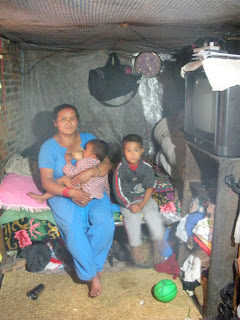
We stayed for about 20 minutes. The mother told me about her life and family (translated through Bina), whilst I played ball with the boys. But I couldn't wait to go. The place made me feel sick, both physically and emotionally. I found being there far more affecting, even, than being at Khokana leprosy colony. Although the conditions there are horrible and the LAPs suffer terribly, leprosy is, thankfully, relatively uncommon these days. Relatively uncommon, that is, compared to the daily poverty experienced by Nishant's family and millions, even billions, like them. What particularly tweaked me was realising that I had cycled past his home almost every day on the way to and from the gym, without ever stopping to think about who lived behind the walls and the kind of life they have. That's to say, whilst I've been having a very comfortable time in Kathmandu, I've been surrounded by poverty all the while and barely noticed it outside of OGN.

Poverty and OGN

On Monday Bina took me to see the homes and workplaces of the families of a couple of kids at OGN.  Their poverty is shocking and I found the visit terribly upsetting.  I'll let the pictures do most of the talking.

One mother, recently widowed and left with three children under the age of ten, outside the shack in which they all live.  Generously estimating the dimensions of the place, the family lives in a room no bigger then 5m by 5m:


Inside the shack.  That's all there is too it, apart from one small storage until just out of frame on the bottom right where a few kitchen utensils are stored:


The field outside.  The shack is just out of shot on the left.  On the right you can see the outhouse, with the blue door.  In between is where the mother works, making paper, some of which is drying in the stacked frames:

It's not much of a life, to put it mildly.

Sunday, 22 March 2009

'Women in Concert' concert and a day of luxury

A while ago I mentioned that I had joined a choir and would be performing in a concert on March 21st.  I promised a post-event post, so here it is.

Between my first enthusiastic post about my musical exploits and the day of the concert itself, I had begun seriously regretting the undertaking.  Rehearsals were held far away and cut into precious weekend sightseeing time.  I wouldn't have minded so much if the rehearsals had displayed any semblance of organisation (like, say, not having to wait for an hour for it to begin or getting there to find that most members of the choir either hadn't been informed of the rehearsal or hadn't turned up) or if there was any sense of improvement as the weeks wore on.  On one particularly frustrating occasion, Sapna and I spent the entirety of a rehearsal stuck in a traffic jam as a result of roadblocks, eventually arriving one and a half hours after we set off on the usually twenty minute journey.  On that day only, the rehearsal had started on time and had just finished when we arrived.

But, in much the same way as the wedding came together at the last minute, the concert turned out to be a success.  It was held at a beautiful five star hotel, the Gorkana Forest Resort, on the outer edge of Kathmandu Valley.  The concert was held outside, the stage set up under massive ancient trees.  The whole thing felt much more like a rock concert than I expected, with a high stage, impressive sound system, lack of seating and surprisingly vocal, cheering crowd (more so as the evening continued and bar stocks became increasingly diminished).  Here's a shot of Sapna performing her solo:


By the time the choir came on, last act of the night, everyone was exceedingly jolly.  It was quite clear that not everyone on stage was entirely sober but that just added to the fun.  I couldn't hear myself sing at all and therefore have no idea if I did so in tune.  Despite being entirely sober, with all the jollity around me I threw caution to the wind, belted in out and danced along with full gusto.  It was huge amounts of fun.  Rabi took the following photo on my camera.  It's not great but it's the best I have.  I'm second from the right.  For better pics, check out the gallery here.  

We stayed overnight at the resort and I spent Sunday making the most of the spa.  Delighted to have an opportunity to swim for the first time in months, I dived right in and, to my great surprise, swam 150 lengths, approximately 2250m, or double what I normally swim.  I seems that all those aerobics classes are paying off in terms of improved fitness and stamina.  I also had a message, a facial (only the second in my life) and enjoyed a few stints in the sauna and jacuzzi.  It was utterly indulgent.  It was only when I got back to Kathmandu that I reflected on the diversity of my week, starting at Khokana and ending at Gorkana, about as far apart on the spectrum as two places can be.